
Social casino versus real-money gambling
Woohoo Casino Real Money vs Social Casino: The Difference
 Available in AU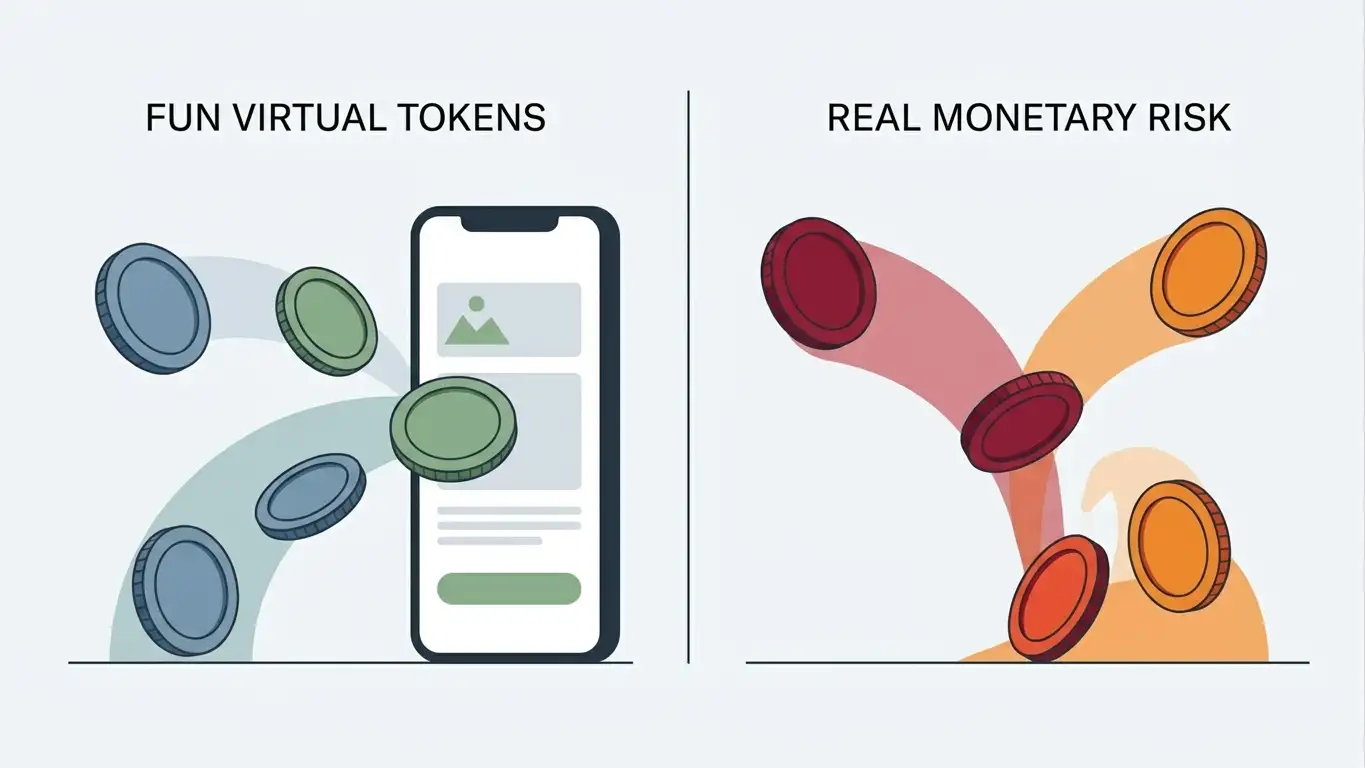
Woohoo Casino’s app is a social or simulated casino product, not a real-money casino. It uses casino-style games and virtual rewards, but those rewards cannot be cashed out. A real-money casino, by contrast, involves staking money or something of monetary value with the possibility of receiving money or another prize of monetary value. For Australian users, that difference matters both practically and legally: similar-looking interfaces can sit on opposite sides of the line between simulated entertainment and gambling for money.
Table of Contents
- The core difference is what happens to value
- Simulated gambling can still look like casino gambling
- Australian law focuses on the service being provided
- Why in-app purchases do not erase the distinction
- Questions that quickly identify the product model
- How Australian users can avoid category mistakes
- Real spending and real-money gambling are not the same test
- Why the distinction matters for consumer expectations
- Use stable facts and live details for different jobs
- A simple decision framework for Australian users
- Keep the product model visible when comparing details
- The practical line between social play and gambling for money
The core difference is what happens to value
In Woohoo, virtual coins are used inside the app and are not a cash-out balance. The app also includes in-app purchases, so users can spend real money on virtual content, but that does not establish a route for converting the resulting virtual balance back into cash.
Real-money gambling has a different value loop. The player stakes money or monetary value on an uncertain outcome, and the product may return money or a prize of monetary value. That financial possibility is what makes withdrawal rules, payout methods and gambling-account balances relevant to real-money services but not to Woohoo’s social-casino model.
| Question | Woohoo social casino | Real-money online casino |
|---|---|---|
| What is used in play? | Virtual game currency | Money or monetary value |
| Can the balance be cashed out? | No | Potentially, under operator terms |
| Can users spend real money? | Yes, through in-app purchases | Typically through deposits where the service is lawful |
| Does casino-style presentation prove real-money gambling? | No | No – the value model must be established |
Simulated gambling can still look like casino gambling
The absence of cash-out does not mean the experience looks unrelated to gambling. Woohoo is presented as simulated gambling and uses slot-machine styles. Reels, wins, coin totals and reward loops can reproduce much of the visual rhythm of casino play even when the outcome has no cash redemption value.
This is why product classification should be based on how value works rather than on interface images alone. A slot-like screen does not tell you whether a stake is real money, whether a prize has monetary value or whether funds can be withdrawn. Those are separate facts that need to be established for the specific product.
Australian law focuses on the service being provided
Australia’s Interactive Gambling Act 2001 sets rules for online gambling services. ACMA states that providers must not offer certain prohibited online services to people in Australia, including online casinos. The legislation also distinguishes categories of services and defines the Australian-customer link used in its provider-side prohibitions.
That framework should not be simplified into the claim that every casino-themed mobile game is an illegal online casino. The Woohoo identity discussed here is an R18+ simulated-gambling app with virtual rewards that cannot be cashed out. The relevant comparison is therefore between a social-casino entertainment model and the real-money services addressed by gambling law.
Why in-app purchases do not erase the distinction
A common source of confusion is that social casino apps can accept real-money purchases. Spending money inside an app can create a financial cost for the user, but cost alone does not make the resulting virtual coins withdrawable. A paid coin bundle can still be a consumable entertainment purchase rather than a gambling deposit.
This matters when budgeting. A user can lose money economically by repeatedly buying virtual items even though the app does not offer cash gambling winnings. The sensible control is therefore to treat purchases as entertainment spending with a fixed budget, not as capital that might later be recovered through a withdrawal.
Questions that quickly identify the product model
Start with three questions. Can the balance be redeemed for cash? Does play involve staking money or monetary value for a chance at a monetary prize? Is there an actual withdrawal mechanism tied to the product? For Woohoo, the information answers the first and third questions in the negative: its virtual rewards cannot be cashed out and no real-money withdrawal model is established.
If your main concern is the withdrawal question, the Woohoo Casino cash-out guide explains why standard payout times and withdrawal limits do not apply to the app. Keeping that distinction clear also prevents details from unrelated, similarly named casino sites from being attributed to Woohoo.
How Australian users can avoid category mistakes
Check the exact app name, developer and store listing before relying on a review or search result. Woohoo’s app identity is associated with Superfun Games Co., Limited and is available on Android and iOS. Product identity is especially important when names overlap with unrelated gambling websites or software providers.
Next, read reward language literally. “Coins” or a large welcome figure should not be treated as dollars unless the product establishes a monetary denomination and redemption mechanism. Finally, distinguish regulation of real-money online casino services from the separate consumer question of whether simulated gambling and in-app spending are appropriate for you.
Real spending and real-money gambling are not the same test
A social casino can cost money because it sells in-app content, yet still lack the defining cash-out loop associated with real-money casino play. Woohoo illustrates that distinction. Users can make optional purchases, but the virtual rewards remain virtual and cannot be redeemed as cash. The existence of a purchase button therefore answers a spending question, not a withdrawal question.
This distinction is useful because otherwise any paid mobile game with casino-style graphics could be mistaken for a real-money casino. The more reliable approach is to trace value through the product: what the user buys, what is used during play, what can be won inside the app and whether anything can leave the app as money or another monetary prize.
Why the distinction matters for consumer expectations
Different product models create different practical risks. In a social casino, one concern is repeated entertainment spending on virtual content. In a real-money gambling service, users also need to understand staking, monetary winnings, account balances and withdrawal rules. Mixing those frameworks can lead users to look for protections or features that do not belong to the product they actually installed.
For Woohoo, the clearest expectation is that casino-style play and virtual progression happen inside the app. Users should budget purchases as entertainment costs and should not plan around recovering those purchases through cash-out. That framing is consistent with the app identity and avoids attaching real-money casino mechanics to a product that does not establish them.
Use stable facts and live details for different jobs
Some Woohoo details are stable enough to anchor a decision: the product is a social or simulated casino app, it is associated with Superfun Games Co., Limited, it has Android and iOS versions, it includes in-app purchases, and its virtual rewards cannot be cashed out. Those points describe what the product is. They are more important than temporary event names, changing store artwork or a particular virtual-coin promotion.
Live details serve a different purpose. Current purchase packages, promotional rewards, software requirements and the presentation of individual features can change as the app is updated. When one of those details matters to a decision, check the current app or platform listing rather than assuming an older description still applies. This keeps the review useful without turning a time-sensitive detail into a permanent promise.
A simple decision framework for Australian users
First decide what you want from the product. If the goal is casino-style mobile entertainment using virtual currency, Woohoo’s product model fits that description. If the goal is to wager for cash or withdraw winnings, the app does not provide that value loop. Making that distinction before comparing individual features prevents the casino theme from creating the wrong expectation.
Next, separate product identity, spending and regulation. Confirm the developer so that information from another service is not mixed in. Treat optional purchases as real entertainment expenditure even though the purchased content is virtual. Finally, use Australian gambling rules as context for real-money services without assuming they automatically classify every simulated casino app. These checks keep the practical questions tied to the product that is actually being used.
Keep the product model visible when comparing details
Woohoo can use familiar casino language without giving every term the meaning it would have at a real-money operator. Coins are virtual play resources, optional purchases are entertainment spending, and rewards are not a cash-out balance. Keeping those definitions visible makes feature comparisons more accurate. It also prevents a temporary promotion or a casino-style interface from overriding the basic information about how value works in the app.
For Australian users, this is a practical safeguard as much as an editorial distinction. Confirm the exact app and developer, check live store information when a detail can change, and do not import deposit, withdrawal or licensing claims from a different service simply because the name looks similar. The result is a clearer decision based on Woohoo’s published characteristics rather than assumptions about casinos in general.
The practical line between social play and gambling for money
For Woohoo, the practical line is the absence of real-money cash-out from its virtual rewards. The app can imitate casino play, use virtual coins and sell in-app content without becoming the same thing as a real-money online casino. Australian law provides important context for real-money interactive gambling, while the Woohoo product itself should be described according to its simulated-casino model. For more on the Australian regulatory context, continue to the Woohoo Casino Australia guide.
Prepared by the Woohoo Casino editorial staff.